Hard Water and Your Skin: What Helps in the UK
If your kettle furs up and your shower screen is always cloudy, you live in a hard water area, along with most of southern and eastern England. Many people in these regions notice that their skin feels tight after washing, or that eczema is harder to control, and wonder whether the water is to blame. The honest answer is that it can play a part, and that a few inexpensive changes usually help more than expensive gadgets.
Part of our guide to body and other. Start with: 10 Best Body Tools for Skincare and Massage (2026): Smooth and Relax
Hard water contains high levels of calcium and magnesium. These minerals react with soap to form a residue that is hard to rinse away, and research suggests hard water can weaken the skin barrier and make skin more sensitive to irritants, particularly in people prone to eczema. It does not harm everyone. The most effective steps are to swap soap for a soap-free cleanser, wash with lukewarm water for a shorter time, pat dry, and apply a moisturiser or emollient within a few minutes. Micellar water is useful on reactive days. Shower filters mainly reduce chlorine and do not soften water, so treat them as optional.
Products That Help in Hard Water Areas


Links go to Amazon.co.uk. As an Amazon Associate I earn from qualifying purchases.
Turn skincare time into me-time with a free audiobook
In short: change how you wash and moisturise first; filters and softeners come a distant second.
UK research from the University of Sheffield and King’s College London found that hard water can damage the skin barrier, while a large NHS-funded trial found that installing a water softener did not improve eczema in children who already had it. The NHS advises emollients and soap substitutes as the basis of care for dry skin and eczema.
I am Rakib Sarwar, a registered pharmacist with a cosmetology course. This guide explains what hard water does, where it is found in the UK, and what helps, with a few well-rated products on Amazon UK as examples. This is general information, not medical advice. As an Amazon Associate I earn from qualifying purchases.
What to Know First
- Hard water is common across southern and eastern England.
- Its minerals react with soap and leave a residue on the skin.
- Studies link hard water with a weaker skin barrier, especially in eczema-prone skin.
- Soap-free cleansers and prompt moisturising make the biggest difference.
- Shower filters reduce chlorine but do not soften water.
- A trial found water softeners did not improve existing childhood eczema.
In This Guide
- What Is Hard Water?
- Where Is Hard Water Found in the UK?
- How Hard Water Can Affect Your Skin
- Hard Water and Eczema: What the Evidence Says
- Swap Soap for a Soap-Free Cleanser
- Use Micellar Water on Reactive Days
- Moisturise Within Minutes of Washing
- Do Shower Filters Help?
- What About a Water Softener?
- A Simple Skin Routine for Hard Water Areas
- Hard Water, Hair and Scalp
- Dos and Don’ts
- FAQ
- The Takeaway
What Is Hard Water?
Hard water is water with a high concentration of dissolved minerals, mainly calcium and magnesium. It picks these up as rain filters through chalk and limestone before it reaches the reservoir or borehole. Soft water comes from areas with harder rock such as granite, where fewer minerals dissolve.
Hard water is safe to drink and is not a health hazard. You can recognise it by limescale in the kettle, white marks on taps and shower screens, and soap that is slow to lather.
Hardness is measured in milligrams of calcium carbonate per litre. Your water supplier publishes the figure for your postcode on its website.
Water companies usually group results into bands such as soft, moderately soft, slightly hard, moderately hard, hard and very hard. Anything above about 200 milligrams per litre is generally classed as hard.
Where Is Hard Water Found in the UK?
Water hardness varies a great deal across the country.
| Region | Typical hardness |
|---|---|
| London and the South East | Hard to very hard |
| East Anglia and the East Midlands | Hard to very hard |
| Central southern England | Hard |
| Yorkshire, North East | Mixed, soft to hard |
| South West (Devon, Cornwall) | Mostly soft |
| North West England | Mostly soft |
| Wales | Mostly soft |
| Scotland | Mostly soft |
| Northern Ireland | Mixed, mostly soft to moderate |
These are broad patterns, and hardness can differ between neighbouring towns. Check your own postcode with your water company for an accurate figure.
How Hard Water Can Affect Your Skin
Hard water affects skin in a few connected ways.
- Soap scum: calcium and magnesium react with traditional soap to form an insoluble film that clings to skin and is hard to rinse off.
- More product: because soap and wash products lather poorly, people tend to use more, which increases contact with detergents.
- Barrier damage: laboratory research found that hard water leaves more surfactant residue on the skin and increases water loss and irritation, particularly in people with eczema.
- Higher pH: hard water is usually slightly alkaline, while healthy skin is slightly acidic.
- Dryness and tightness: the combined effect for some people is skin that feels dry, itchy or tight after washing.
Children and babies have thinner, more permeable skin than adults, which may be one reason the link with eczema shows up most clearly in early childhood.
Not everyone notices a difference. People with normal, resilient skin often have no problems, while those with dry skin, eczema or a damaged barrier are more likely to react. If almost everything stings, see our guide on how to repair the moisture barrier.
Hard Water and Eczema: What the Evidence Says
Several UK studies have found that eczema is more common in children living in hard water areas, and a study of infants found a higher risk of eczema where water was harder. This shows an association, not proof that hard water causes eczema.
Laboratory work at the University of Sheffield showed a plausible mechanism: hard water increased the amount of wash-product residue on skin and made the barrier more vulnerable to irritation, especially in people with a filaggrin gene variant linked to eczema.
On the other hand, the Softened Water Eczema Trial, a large NHS-funded study, tested ion-exchange water softeners in the homes of children with moderate to severe eczema and found no meaningful improvement compared with usual care. Research into whether softened water might help prevent eczema in babies is still under way.
The practical message is that standard eczema care, meaning emollients, soap substitutes and prescribed treatments, matters far more than changing the water.
Swap Soap for a Soap-Free Cleanser

This is the single most useful change. Traditional soap is what reacts with hard water minerals, so removing it removes most of the residue problem.
Soap-free cleansers, sometimes called syndets, and emollient wash products clean with milder surfactants that do not form scum. CeraVe Hydrating Cleanser is a non-foaming lotion with ceramides, and Cetaphil Gentle Skin Cleanser is a very simple formula that can be used on the face and body.
Use a small amount, massage gently with your fingertips and rinse well. For more options, see our guide to the best cleansers for sensitive skin in the UK.
Use Micellar Water on Reactive Days

If tap water itself seems to sting, you can cleanse your face without it now and then. Micellar water lifts make-up, sunscreen and oil onto a cotton pad.
Garnier Micellar Cleansing Water is the best known in the UK and is sold in large bottles. Choose the version for sensitive skin and press, do not scrub, with the pad.
Micellar water contains mild surfactants, so some people prefer to follow it with a quick splash of water or a hydrating mist. It is a useful option for mornings and for flare-ups, not a requirement for every wash.
Moisturise Within Minutes of Washing

Moisturising straight after washing replaces what the water has taken out and helps the skin barrier recover. Aim to apply it within about three minutes, while skin is still slightly damp.
Pharmacy emollients are effective and good value. E45 Moisturising Cream is a rich, unperfumed cream for face and body, and Cetraben is an emollient cream often recommended for very dry and eczema-prone skin.
Paraffin-based emollients can soak into fabric and make it more flammable, so keep away from naked flames and wash clothing and bedding regularly. Our guide to the best moisturisers for dry skin in the UK has more choices.
Do Shower Filters Help?

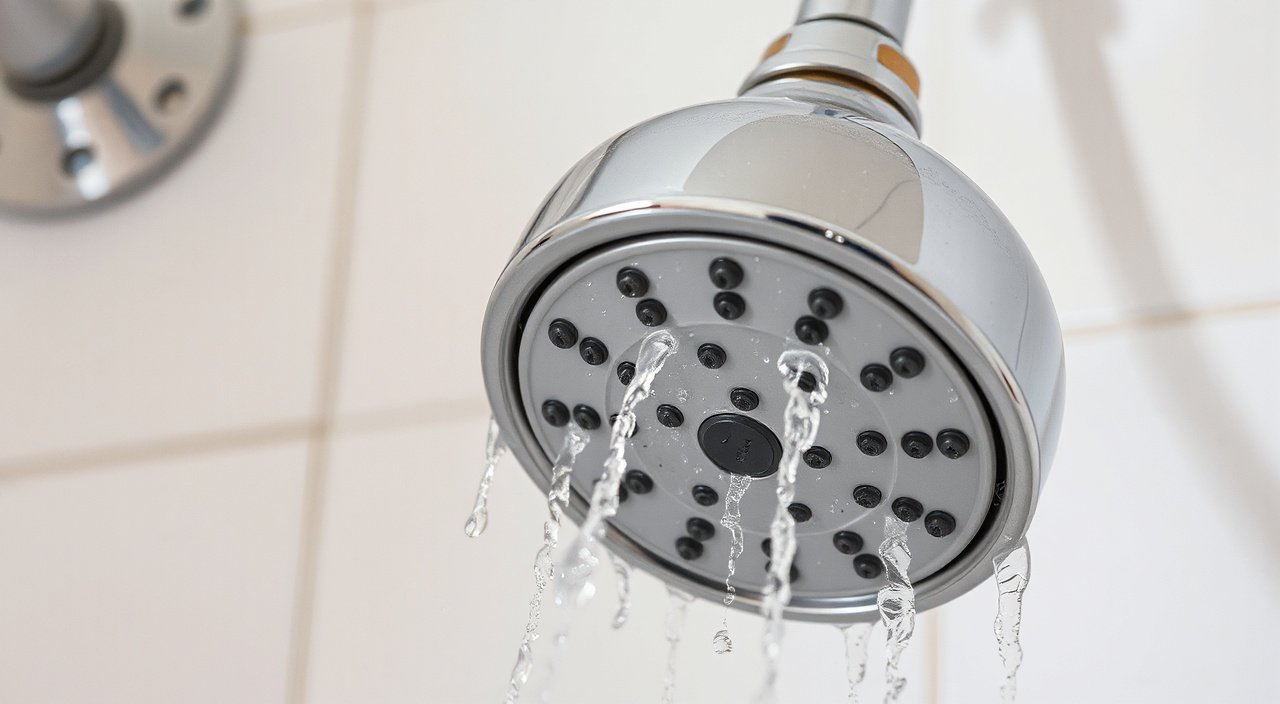
Shower filters are heavily marketed for hard water, so it is worth being clear about what they do. Most screw-in filters use carbon, KDF or vitamin C media that reduce chlorine and some sediment. They do not remove meaningful amounts of calcium and magnesium, so they do not soften water, whatever the packaging implies.
| Option | What it does | Softens water? |
|---|---|---|
| Screw-in shower filter | Reduces chlorine and sediment | No |
| Filtered shower head | Reduces chlorine; changes spray pattern | No |
| Ion-exchange water softener | Swaps calcium and magnesium for sodium | Yes |
| Magnetic or electronic conditioner | Aimed at limescale in pipes | No |
Some people still find their skin and hair feel better with a filter, possibly because of the lower chlorine level. The weAQUA shower filter and filtered shower head sets like the one listed above are popular, well-reviewed examples on Amazon UK.
Treat a filter as an optional extra to try after you have changed your cleanser and moisturising habits. Replace cartridges as the maker advises, since an old cartridge does nothing.
Check the current listing for what a filter is tested to remove and how often cartridges need replacing. We do not quote prices because they change often.
What About a Water Softener?
A true water softener is a plumbed-in ion-exchange unit that swaps calcium and magnesium for sodium. It does soften water, reduces limescale and makes soap lather easily.
It is a significant purchase with running costs for salt and servicing, and the main UK trial found no benefit for children with established eczema. Softened water contains more sodium, so a separate unsoftened tap is usually kept in the kitchen for drinking and for making up infant formula.
A softener can be worthwhile for protecting appliances and plumbing, and some adults do feel their skin is more comfortable. It is hard to recommend one for skin reasons alone.
A Simple Skin Routine for Hard Water Areas
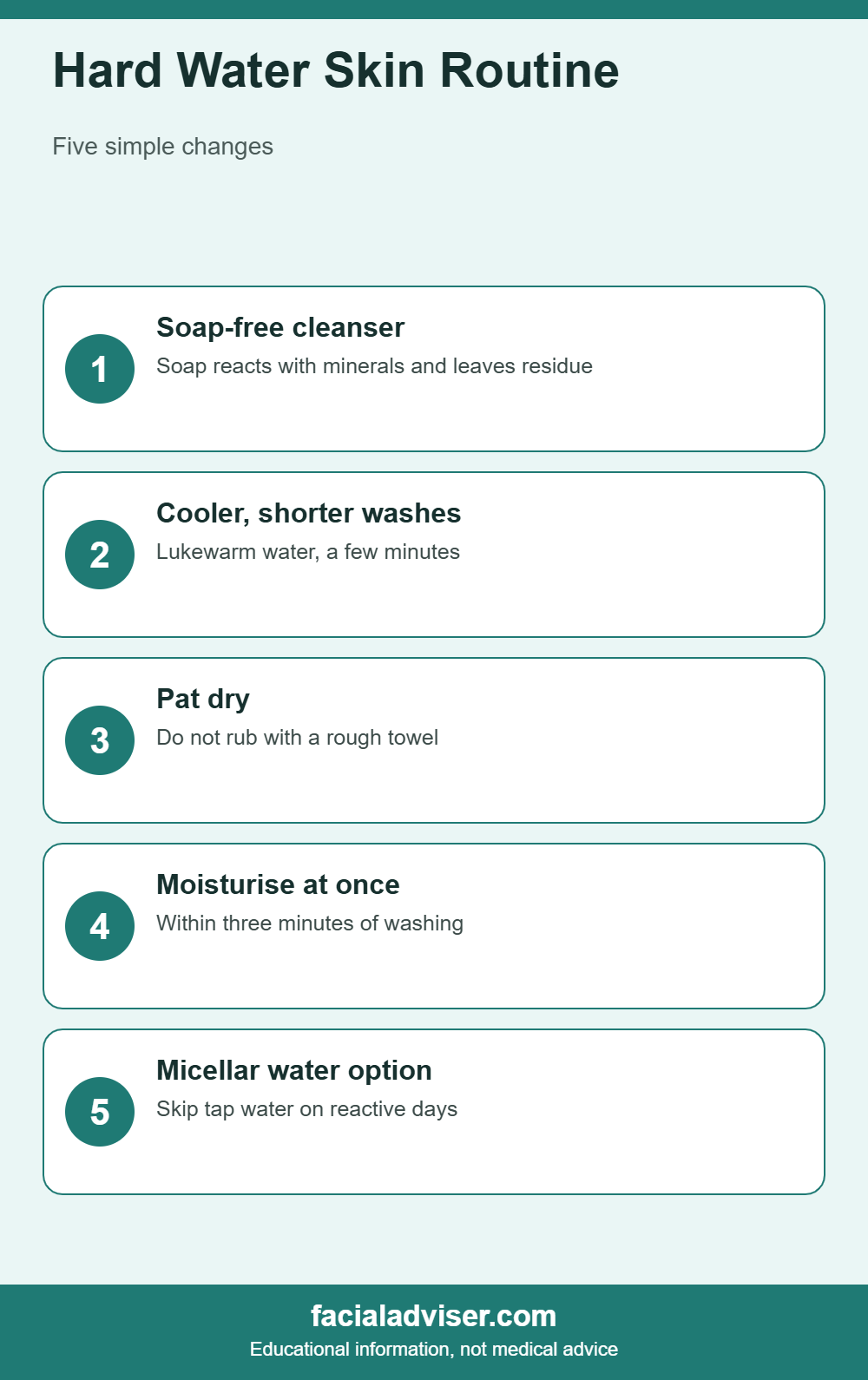
These steps cost little and cover what matters most.
Use a soap-free cleanser
Replace bar soap and strong foaming washes on the face and body.
Turn the temperature down
Lukewarm water is kinder than hot.
Keep it short
A five to ten minute shower is plenty.
Rinse thoroughly
Make sure no wash product is left on the skin or scalp.
Pat dry
Use a soft towel and do not rub.
Moisturise within three minutes
Apply an emollient or moisturiser to slightly damp skin.
Protect your hands
Use a soap substitute at the sink and reapply hand cream after washing.
For your face, try washing with cleanser in the evening only and using micellar water or a splash of water in the morning. Less contact with detergent often helps more than any filter.
Give these changes three to four weeks before you judge them. Skin that has been dry and irritated for a long time recovers gradually, and it is easier to tell what is working if you change one thing at a time.
Hard Water, Hair and Scalp
The same minerals can build up on hair, leaving it dull, rough or difficult to lather, and some people notice a dry, itchy scalp.
A gentle shampoo, thorough rinsing and an occasional clarifying or chelating shampoo, which is designed to remove mineral build-up, can help. Finish with conditioner on the lengths.
If your scalp is flaky, red or sore, it may be seborrhoeic dermatitis or psoriasis and not the water. A pharmacist can advise on medicated shampoos.
Dos and Don’ts
Good Habits
- Check your postcode’s water hardness
- Use soap-free cleansers and emollient washes
- Moisturise straight after washing
- Keep showers short and lukewarm
- Follow your eczema treatment plan
Common Mistakes
- Expect a shower filter to soften water
- Scrub skin to remove residue
- Use bar soap on dry or eczema-prone skin
- Take long, hot baths
- Stop prescribed treatments because you have changed the water
See a pharmacist or GP if your skin is cracked, weeping, very itchy or not improving after two to three weeks of regular moisturising. Eczema, psoriasis and contact dermatitis need proper assessment, and babies with eczema should be seen by a health professional.
This article is general educational information and is not a substitute for advice from your own GP, pharmacist or dermatologist. Product details were checked on Amazon UK at the time of writing and can change. Always read the label and follow the directions for use.
FAQ
Does hard water damage your skin?
It can weaken the skin barrier in some people, especially those with dry or eczema-prone skin. Many people notice no effect.
Which parts of the UK have hard water?
Mainly London, the South East, East Anglia and parts of the Midlands. Scotland, Wales, the North West and the South West are mostly soft.
Does hard water cause eczema?
Studies show eczema is more common in hard water areas, but that does not prove cause. It may make existing eczema harder to manage.
Do shower filters soften water?
No. Most reduce chlorine and sediment but do not remove the calcium and magnesium that make water hard.
Will a water softener help my eczema?
A large UK trial found no meaningful benefit for children with established eczema. Emollients and soap substitutes matter more.
What is the best cleanser for hard water areas?
A soap-free, low-foaming cleanser, because it does not react with the minerals the way soap does.
Does hard water cause acne?
There is no good evidence that it causes acne. Residue and irritation might aggravate sensitive skin.
Should I wash my face with bottled or filtered water?
It is not necessary. Micellar water is a simpler option if tap water irritates your skin.
Is hard water bad for hair?
Minerals can build up and leave hair dull or rough. A chelating shampoo used occasionally can help.
How do I find out how hard my water is?
Enter your postcode on your water company’s website, which lists hardness for your supply zone.
The Takeaway
Hard water is a fact of life across much of England, and for some people it does make skin drier and more reactive. The fixes that work are simple: replace soap with a soap-free cleanser, keep washing short and lukewarm, and moisturise straight afterwards.
Shower filters and softeners are optional extras, not solutions, and the evidence for them is limited. If your skin stays sore, itchy or inflamed, ask a pharmacist or GP for advice.

Written by
Registered pharmacist and founder of Facial Adviser. Rakib's pharmacy training covers how skincare actives work and interact; a later course in cosmetology turned that into a focus on facial treatments and skincare products. He plans, researches and edits every guide on the site and checks health claims against sources such as the American Academy of Dermatology, the FDA and the NIH. He is not a dermatologist; see the Editorial Policy and Medical Disclaimer.
About · Editorial policy · How we choose products · Medical disclaimer · Contact
Keep reading: Body care and more
- 10 Best Body Tools for Skincare and Massage (2026): Smooth and Relax
- Best Eye Creams in the UK: 7 Eye Creams Worth Trying
- Best Hand Creams in the UK: 7 Hand Creams for Dry, Cracked Skin
- Best Lip Balms in the UK: 7 Lip Balms for Dry, Chapped Lips
- Is a Muscle Massage Gun Worth It? What the Evidence Says and Who Benefits
- Jeroboam Gozo Perfume: Notes, Wear and Who It Suits
Black Friday is coming: shop the deals with Prime