Will Microneedling Reduce Pore Size?
Does microneedling reduce pore size in a way that actually holds up, or is this another claim that depends entirely on what’s driving your pore appearance in the first place?
A pore is a structural opening, not a muscle, so it can’t literally “close” the way product claims imply — and the strongest dedicated pore-reduction evidence exists for energy-augmented radiofrequency microneedling, not plain mechanical microneedling alone. That distinction changes what a realistic result actually looks like.
Even in the better-studied version of this treatment, single-session improvement rates run in the low-to-mid teens percentage-wise, far more modest than marketing language suggests.
This guide covers what really determines pore size, what the direct evidence supports, and how to set expectations that match the actual research.
Recommended At-Home Microneedling Devices for Texture
What a “Pore” Actually Is
Before asking whether microneedling reduces pore size, it helps to know what a pore actually is. Per DermNet NZ, pores are the visible surface openings of a pilosebaceous unit — a hair follicle with its attached sebaceous (oil) gland — or, less commonly, an eccrine sweat duct. A pore isn’t a muscle that can contract or relax, which is worth keeping in mind any time a product or treatment claims to “close” or “shrink” pores as if they were an aperture with a switch.
What most people mean by “large pores” is really the combined visual effect of several separate, mostly structural factors — and most topical products and many devices, including plain microneedling, address only some of them. Understanding which factor is actually driving your own pore appearance is the difference between choosing a treatment with a real mechanistic case and one riding on marketing language alone. For the treatment’s broader evidence base, see our main microneedling facial guide.
Core Takeaways
- A pore is a follicle opening, not a muscle — it can’t literally “close” or “open” the way marketing often implies.
- Sebum output, hair follicle size, and loss of surrounding elastic tissue are the three documented drivers of perceived pore size.
- Pore size genuinely fluctuates with hormones, including a documented mid-cycle change around ovulation in women.
- Most of the strongest “pore reduction” evidence is for energy-augmented (radiofrequency) microneedling, not plain mechanical microneedling alone.
- Even RF-microneedling’s single-session improvement rates run in the low-to-mid teens percentage-wise — far more modest than marketing language implies.
- Microneedling’s strongest, most consistent evidence is for acne scarring and general texture, not pore size as a dedicated, isolated outcome.
Guide Sections
- What a “Pore” Actually Is
- What Really Determines Pore Size
- Microneedling’s Real Mechanism vs. Pore Size Specifically
- What the Direct Evidence Shows
- Realistic Expectations and Session Counts
- What a Microneedling Session Aimed at Pores Involves
- Who Should Consider This Specifically for Pores
- When Microneedling Isn’t the Right First Step
- When to See a Dermatologist Instead
- A Practical Way to Identify Your Own Pore Driver
- Where the Evidence Runs Out
- Frequently Asked Questions
What Really Determines Pore Size
An MDedge clinical review, “Enlarged Facial Pores: An Update on Treatments,” identifies three documented drivers. First, sebum output: the review states “the direct relationship between sebum output and pore size has been well established, particularly in men,” since testosterone drives sebaceous gland activity. Pore size also visibly fluctuates in women around ovulation, when progesterone affects the sebaceous glands — a genuinely underused fact, since most pore content frames this as purely an aging issue rather than something that shifts across the menstrual cycle too.
Second, loss of surrounding elastic tissue: skin elasticity shows a documented negative correlation with facial pore size and density. Aging and photodamage reduce collagen and elastin and specifically decrease expression of microfibril-associated glycoprotein-1 (MAGP-1), a protein needed for elastic fiber assembly around the follicular opening — this is the mechanism behind pores appearing to “stretch out” and lose their ability to snap back over time. Third, and per the same review “most clinically relevant to the pathogenesis of enlarged pores,” is hair follicle size itself: people with genetically larger native follicles simply have more visible pores regardless of sebum output or elasticity. Comedogenic product buildup, acne (which can structurally weaken the follicle opening), and chronic sun damage round out the picture.
| Driver | How it affects pore appearance | Can microneedling plausibly help? |
|---|---|---|
| Sebum output | More visible, often stretched-looking openings | Not directly — needling doesn’t reduce oil production |
| Elastic tissue loss | Pores lose ability to appear tight/snap back | Plausible — matches microneedling’s real collagen mechanism |
| Native follicle size | Baseline pore visibility, largely genetic | No — structural, not something a device changes |
Microneedling’s Real Mechanism vs. Pore Size Specifically
Microneedling’s well-evidenced mechanism is collagen induction: controlled micro-injury triggers a wound-healing cascade of growth-factor release, fibroblast activation, and new collagen and elastin deposition over the following weeks. Since elastic-tissue loss is one of the three documented drivers of pore appearance above, there’s a genuinely plausible mechanistic pathway — restoring peri-follicular elastic support could make pores look visually tighter. That said, this is a plausibility argument built from a known mechanism and a known driver, not a confirmed result from dedicated microneedling-for-pores trials, and it’s worth being precise about that distinction rather than treating plausibility as proof.
What the Direct Evidence Shows
Most of the strongest pore-specific evidence in the literature is for energy-augmented microneedling — specifically radiofrequency (RF) microneedling — not plain mechanical microneedling alone. A retrospective observational study of 75 patients treated with fractional microneedle radiofrequency for enlarged pores (PubMed, covering a 2019-2020 treatment period) found, after just the first session, “moderate to excellent” improvement rates of only 13.8% for nasal pores, 8.9% for the forehead, and 11.1% for the cheeks — modest single-session results that improved with additional sessions, averaging 1.7 sessions with some patients receiving up to 5. Longer pulse-width settings performed significantly better than shorter ones.
Newer studies combining microneedling with exosome therapy exist for pore reduction, but exosome treatment isn’t FDA-approved as a drug or biologic for this use in the US, making that research a different and regulatorily murkier category than standard microneedling. For useful contrast, a topical comparison point exists too: in a 24-week trial, tazarotene 0.1% cream, a topical retinoid rather than a device, achieved pore-appearance improvement of at least one point in 42% of treated patients versus 20% of placebo patients — a real benchmark for comparing device-based approaches against a well-studied topical option.
| Approach | Reported result | Evidence tier |
|---|---|---|
| RF-microneedling, single session | 8.9%-13.8% “moderate to excellent” improvement by area | Retrospective observational, 75 patients |
| Tazarotene 0.1% cream, 24 weeks | 42% improved at least 1 point vs. 20% placebo (P<.001) | Controlled trial, topical comparison |
Realistic Expectations and Session Counts
Across the studies located, meaningful pore-appearance change required multiple sessions rather than one — the RF-microneedling study averaged 1.7 sessions with room for up to 5, and general microneedling protocols for overall skin texture typically run 3-6 sessions spaced 4-6 weeks apart. A single session, plain or RF-augmented, shouldn’t be marketed or expected to produce durable, dramatic pore-size change on its own.
What a Microneedling Session Aimed at Pores Involves
Skin assessment
The provider identifies your specific pore driver where possible — oiliness, elasticity loss, or follicle size — to set realistic expectations for what needling can and can’t address.Numbing and cleansing
A topical numbing cream is applied and the skin is thoroughly cleansed before treatment.Needling pass
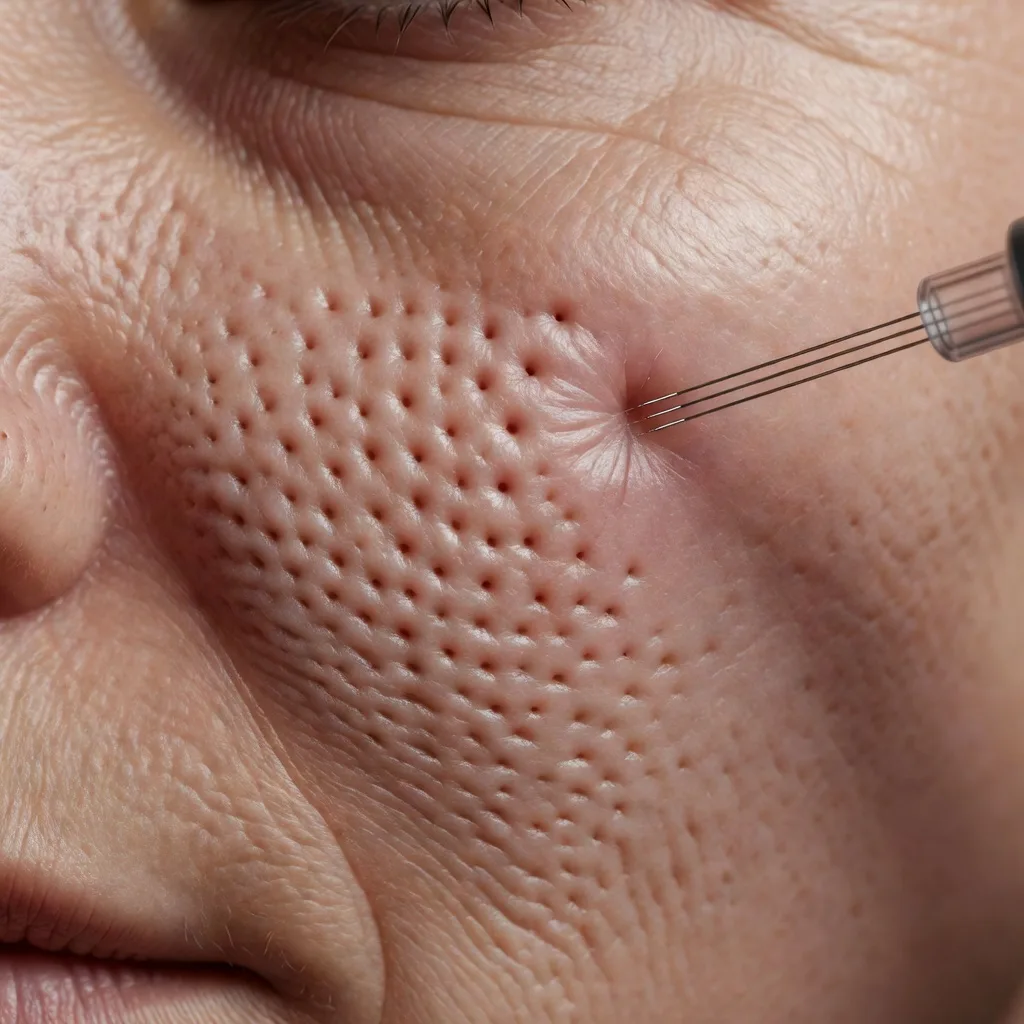
The device, mechanical or RF-augmented, passes over the treatment area at a depth appropriate for the goal, typically with longer RF pulse-widths showing better results per the study above.Post-treatment care
A calming serum and strict sun protection support the weeks-long collagen remodeling process that follows.
Who Should Consider This Specifically for Pores
Someone whose pore appearance is driven mainly by lost elastic tissue — typically a slower, gradual change over years rather than a lifelong feature — has the clearest mechanistic case for microneedling helping. Someone whose main driver is oiliness or genetically larger native follicles is more likely to be disappointed by microneedling specifically for pore size, even though they might still benefit from it for general texture or scarring reasons.
Do
- Identify whether elasticity loss, oiliness, or follicle size is your main driver first
- Set expectations around multiple sessions, not one
- Consider RF-microneedling specifically if pore size is the primary goal, given its dedicated evidence
Don’t
- Expect plain microneedling to reduce sebum output
- Expect a single session to produce dramatic, lasting pore-size change
- Assume “pore-reducing” marketing claims are backed by isolated-microneedling trial data
When Microneedling Isn’t the Right First Step
If oiliness is clearly your main driver, a topical retinoid, niacinamide, or a salicylic-acid-based routine addressing sebum and follicle debris directly is a more logical first step than microneedling, which has no plausible mechanism for reducing oil production. Active acne, active infection, or a compromised skin barrier are also reasons to hold off on needling until those resolve.
When to See a Dermatologist Instead
See a dermatologist rather than self-treating if enlarged pores are accompanied by active or worsening acne, if you’re unsure which driver is behind your own pore appearance, or if you’re considering RF-microneedling specifically and want a professional assessment of whether the energy-augmented version is worth the added cost and downtime over plain microneedling for your situation.
A Practical Way to Identify Your Own Pore Driver
There’s no formal at-home diagnostic test for which specific driver is behind your pore appearance, but a practical proxy exists: blot your skin with oil-absorbing paper at midday — heavy, visible oil suggests sebum is a major driver. Gently stretch the skin around a visibly enlarged pore area — if the pore appears to tighten noticeably when the skin is taut, elastic-tissue loss is likely playing a real role, which is the scenario where microneedling has the clearest mechanistic case.
Where the Evidence Runs Out
Be precise about what’s established here: the three documented drivers of pore appearance (sebum, elasticity, follicle size) come from a real clinical review, and the RF-microneedling study is a genuine, if modest, retrospective dataset. What’s missing is any large RCT isolating plain, non-RF, non-exosome mechanical microneedling as the sole intervention with pore size, specifically, as the primary pre-specified outcome. Most pore-specific literature bundles microneedling with an energy source or biologic adjunct, which makes it hard to credit needling alone for reported results — a real limitation worth stating directly rather than glossing over.
Frequently Asked Questions
Will microneedling reduce pore size?
It may help modestly if elastic-tissue loss is your main driver, but there’s no strong dedicated evidence for plain microneedling alone, and it can’t address oiliness or genetically larger follicles.
What actually causes large pores?
Mainly sebum output, loss of surrounding elastic tissue, and native hair follicle size, per clinical review literature.
Is RF-microneedling better than plain microneedling for pores?
It has the stronger dedicated evidence for pore size specifically, though results are still modest and require multiple sessions.
How many sessions does it take to see a difference?
Studies show meaningful change generally requires multiple sessions — often 3-6 for general texture, or roughly 1.7 on average in the RF-microneedling pore study.
Can pores actually open and close?
No — a pore has no muscle tissue, so it can’t mechanically open or close the way marketing language often implies.
Does pore size change with hormones?
Yes — it can visibly fluctuate in women around ovulation due to progesterone’s effect on sebaceous glands.
Is microneedling better for acne scars or pores?
Its evidence is substantially stronger and more consistent for acne scarring and general texture than for pore size as an isolated outcome.
Can microneedling reduce oily skin?
No — it has no established mechanism for reducing sebum production.
Are microneedling-exosome studies reliable for pore reduction?
They’re early and small-sample, and exosome therapy isn’t FDA-approved for this use in the US, making this a different and less established category than standard microneedling.
What’s a realistic single-session improvement for pores?
Even in the better-studied RF-microneedling data, first-session “moderate to excellent” improvement rates ran only 8.9%-13.8% by area.