Can I Bleach My Hair 2 Days in a Row?
Can I bleach my hair 2 days in a row, or does bleaching again so soon undo any of the first session’s damage control?
Once a section of hair has been bleached, there’s very little melanin left in it to oxidize further — so bleaching again the next day delivers a full second dose of disulfide-bond protein damage while barely lightening the hair any more. Microscopy studies on repeatedly bleached hair confirm this cumulative, dose-dependent damage pattern rather than a single catastrophic failure point at “bleach number two.”
There’s no dermatology-society or FDA guideline that sets an official waiting period; this is cosmetic-chemistry and salon convention grounded in real oxidative-damage research, not a clinical standard.
This guide covers the chemistry behind why re-bleaching so soon barely works, the real risks involved, and what a safer path forward looks like.
Recommended Products for Healthier Bleached Hair
Quick Take
- Bleaching lightens hair and damages it through the exact same chemical reaction — alkaline hydrogen peroxide oxidizing melanin also breaks the disulfide bonds that give keratin its strength, so there’s no way to get one effect without the other.
- Re-bleaching already-processed hair the next day delivers rapidly diminishing lightening (most of the melanin is already gone) while still delivering a full second dose of protein-damaging oxidation to already-weakened hair.
- There is no dermatology or FDA guideline on how many days to wait between bleach sessions — the “wait” rule comes from cosmetic chemistry and salon convention, not a clinical standard.
- Documented real risks include persulfate contact allergy in stylists and clients, and chemical/thermal scalp burns from over-processing — both are published, not hypothetical.
On This Page
- What “Waiting Between Bleach Sessions” Actually Means
- The Real Chemistry of Bleaching
- Why Lightening and Damage Are the Same Reaction
- What Happens to Melanin After the First Bleach
- Why a Second Session So Soon Barely Lightens Further
- What Repeated Bleaching Does, Under a Microscope
- What “Hair Melting” Really Means
- The Persulfate Allergy Risk
- Chemical and Thermal Scalp Burns
- Is There an Official Guideline?
- Same-Day Re-Bleach vs. a Proper Waiting Interval
- Do This, Not That
- If You Feel You Must Re-Bleach Soon
- What This Article Can’t Tell You
- Frequently Asked Questions
What “Waiting Between Bleach Sessions” Actually Means
Bleaching hair two days in a row is technically possible — nothing physically stops you from mixing a second batch of lightener and applying it again — but “possible” and “advisable” are different questions, and the honest answer depends on understanding what bleach is actually doing to the hair shaft each time it’s applied, not just on repeating a salon rule of thumb.
The Real Chemistry of Bleaching
Hair bleach is alkaline hydrogen peroxide, often boosted with a persulfate (ammonium or potassium persulfate) powder for extra lightening power. The peroxide oxidizes melanin pigment granules inside the hair’s cortex, breaking down the pigment’s chemical structure until it no longer absorbs visible light the same way — that’s the lightening effect. This is standard cosmetic-chemistry knowledge covered in reference texts on hair science.
Why Lightening and Damage Are the Same Reaction
The same oxidative reaction that breaks down melanin also attacks the disulfide (cystine) crosslinks that hold keratin protein chains together, converting them into cysteic acid. Those disulfide bonds are what give a hair strand its tensile strength and elasticity. This is the single most important fact in this entire topic: lightening and structural damage are not two separate things that happen to occur together during bleaching — they are the same chemical reaction viewed from two different angles. There is no bleaching formulation, however gentle its marketing, that lightens hair without also weakening its protein structure to some degree.
What Happens to Melanin After the First Bleach
Once a section of hair has been bleached to its target level, most or all of the melanin in that section has already been oxidized away. A 2024 electron-microscopy study (Kim et al., Applied Microscopy) comparing virgin hair to hair bleached through three cycles found that in heavily bleached samples, no melanin granules could be detected in the cortex at all — the pigment was simply gone. That single fact is the key to understanding why bleaching twice in quick succession is a poor trade.
Why a Second Session So Soon Barely Lightens Further
If a section of hair no longer contains meaningful melanin, there’s very little left for a second bleach application to lighten. Re-applying bleach to already-processed hair the next day delivers rapidly diminishing cosmetic return — you’re chasing pigment that’s largely already gone — while still delivering a full second dose of disulfide-bond oxidation to hair that’s already structurally weaker than it was 24 hours earlier. The honest framing isn’t “damage bad, wait longer” as a vague warning; it’s a genuine cost-benefit mismatch: shrinking reward, unchanged (or compounding) risk.
What Repeated Bleaching Does, Under a Microscope
Microscopy research gives a genuinely useful, non-anecdotal picture of what’s happening inside the hair shaft as bleaching cycles accumulate.
| Hair condition | What microscopy studies show |
|---|---|
| Virgin (unbleached) hair | Intact endocuticle pores (roughly 0.1–0.5 micrometers); melanin granules clearly visible in the cortex |
| After 1 bleach cycle | Early cuticle/cortex ultrastructure disruption and measurable protein oxidation (Grosvenor et al. 2018) |
| After 3 bleach cycles | Melanin granules dissolved, variable/enlarged pore structure; in heavily bleached samples, no detectable melanin remained in the cortex (Kim et al. 2024) |
One reassuring nuance from the same research: the macrofibril protein scaffold of the hair shaft remained largely structurally intact even after three cycles in that study — meaning damage is cumulative and dose-dependent rather than an instant catastrophic failure the moment a second bleach touches the hair. That doesn’t make back-to-back bleaching low-risk; it means the risk builds with each additional exposure rather than appearing all at once.
What “Hair Melting” Really Means
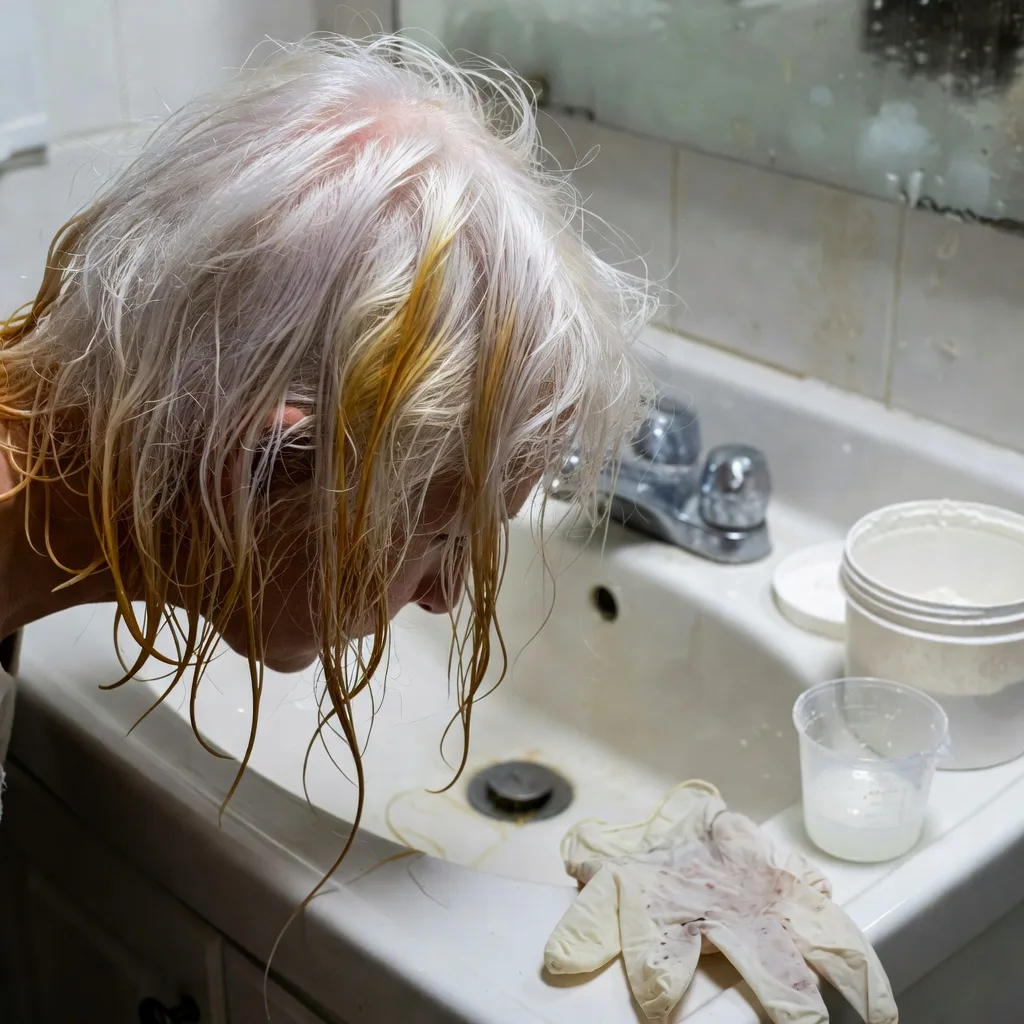
“Hair melting” is an informal industry and forum term, not a clinical one, but it describes something real: severely over-processed hair that, when wet or saturated with more alkaline product, loses tensile cohesion. It can stretch, turn gummy, snap off, or in extreme cases appear to dissolve at the ends. This is the visible, worst-case endpoint of the cumulative keratin hydrolysis documented in the microscopy studies above — not a separate phenomenon, but what advanced protein damage eventually looks like when you can see it with the naked eye instead of an electron microscope.
The Persulfate Allergy Risk
Persulfate boosters, used to push lightening beyond around level 6, are a documented occupational contact allergen and irritant. Published dermatology and occupational-health literature describes persulfate exposure causing both irritant contact dermatitis and, in some cases, IgE-mediated contact urticaria or occupational asthma in hairdressers who handle it repeatedly. This risk applies to repeated exposure generally, and back-to-back sessions mean back-to-back exposure with less recovery time in between for skin that may already be irritated from the first application.
Chemical and Thermal Scalp Burns
Chemical and thermal burns to the scalp from hair bleach and dye are a documented, published clinical phenomenon in the case-report literature, generally tied to excess processing time, excess product strength, or product contact with skin that’s already broken or irritated. Applying bleach over a scalp that’s still irritated or has open micro-abrasions from a bleach session the day before is a more favorable setup for this kind of injury than applying it to calm, intact skin.
Is There an Official Guideline?
No dermatology-society or FDA guideline sets a specific number of days to wait between bleach sessions. The “wait before you re-bleach” advice comes from cosmetic chemistry and salon-industry convention — grounded in real, published chemistry about oxidative damage and diminishing pigment, but not a clinical standard in the way, say, an AAD acne guideline is. It’s worth being precise about that distinction rather than implying medical authority behind salon advice.
Same-Day Re-Bleach vs. a Proper Waiting Interval
| Approach | What actually happens |
|---|---|
| Bleaching again the next day | Minimal additional lightening (little melanin left); full second dose of disulfide-bond oxidation on already-weakened hair |
| Waiting and using a reparative treatment first | Skin/scalp barrier and hair protein structure get time to partially recover; a touch-up targets new growth where melanin is still present |
Anyone with visible scalp irritation, broken skin, a known persulfate sensitivity, or hair that’s already showing signs of over-processing (loss of elasticity, gumminess when wet, visible breakage) should not bleach again until those signs have resolved and, ideally, a professional has assessed the hair’s condition. This is a case where “it still looks blonde enough to try again” is not the same as “the hair and scalp are actually ready.”
Do This, Not That
Do
- Let a colorist assess whether new growth alone needs lightening rather than reprocessing full lengths.
- Use a bond-building or deep-conditioning treatment between sessions if a touch-up is genuinely necessary soon.
- Wait until scalp irritation and hair elasticity have visibly recovered before any further lightening.
Don’t
- Don’t assume a “gentle” or “clean” bleach brand skips the disulfide-bond damage — the chemistry is the same.
- Don’t reprocess already-bleached lengths expecting meaningful further lightening.
- Don’t apply heat-assisted processing over hair that was bleached within the last day or two.
If You Feel You Must Re-Bleach Soon
Have a professional assess the hair first
Check elasticity, porosity, and scalp condition before deciding whether reprocessing is safe.
Target new growth only where possible
Avoid re-lightening already-processed lengths that have little melanin left to remove.
Use a bond-building treatment
A reparative or bond-building step can reduce (not eliminate) further protein damage from a second session.
Skip heat-assisted processing
Heat speeds the reaction and raises over-processing risk on already-weakened hair.
Watch for scalp signs, not just hair color
Tingling, tenderness, or visible irritation are reasons to postpone, regardless of how the color looks.
What This Article Can’t Tell You
This guide can’t tell you an exact, universally safe number of days to wait, because no dermatology or regulatory body has set one — the honest answer depends on your specific hair’s starting condition, porosity, and how aggressively the first session processed it, which is exactly why a professional assessment matters more than a fixed rule.
Frequently Asked Questions
Can I bleach my hair two days in a row?
Physically yes, but it’s not advisable: most of the melanin in already-processed hair is gone after the first session, so a second one soon delivers little extra lightening while adding another full round of protein-damaging oxidation.
Is there an official rule for how long to wait between bleach sessions?
No. There’s no dermatology or FDA guideline on this — the standard “wait” advice comes from cosmetic chemistry and salon convention, not a clinical standard.
Does bleaching damage hair even if it lightens it successfully?
Yes. Lightening and structural damage come from the exact same chemical reaction — oxidizing melanin also breaks the disulfide bonds that give hair its strength, so one doesn’t happen without the other to some degree.
What does “hair melting” actually mean?
It’s an informal term for severely over-processed hair that loses tensile cohesion when wet, becoming gummy, stretchy, or prone to snapping — the visible endpoint of cumulative keratin protein damage.
Are “gentle” or “clean” bleach brands safer to use twice in a row?
They may include bond-building additives that reduce breakage, but they don’t eliminate the underlying oxidative damage to disulfide bonds — the need for a recovery interval still applies.
Can bleaching cause a scalp burn?
Yes, chemical and thermal scalp burns from bleach are documented in the clinical case-report literature, generally tied to excess processing time, strength, or contact with already-irritated skin.
Is persulfate allergy a real risk?
Yes. Persulfate boosters used for extra lift are a documented occupational contact allergen, causing irritant dermatitis and, in some cases, IgE-mediated reactions in people repeatedly exposed to them.
Will re-bleaching lighten my hair further if it’s already very light?
Usually only marginally. If most of the melanin is already gone, there’s little pigment left to remove, so a second session mostly adds risk without much visible benefit.
What should I do instead if I want a lighter look soon after bleaching?
Ask about a toner or gloss, which can shift tone without putting the hair through another full oxidative bleaching cycle.
How can I tell if my hair isn’t ready for another bleach session?
Signs include reduced elasticity, a gummy texture when wet, visible breakage, or ongoing scalp tenderness or irritation from the previous session — all reasons to wait and have a professional assess the hair first.